
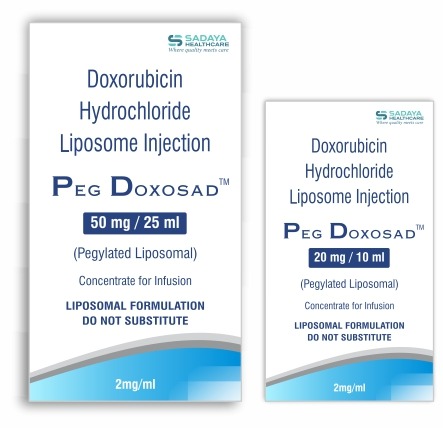
Generic Name/API: PEGylated Liposomal Doxorubicin
Brand Name: Peg-Doxosad
Marketed By: Sadaya Healthcare
Packaging: 1 vial / pack
Storage: 2°C to 8°C
Dosage: Used in multiple types of cancer
Strength: Injection of 1.5 mg
For more Info Fluorouracil_Product
USP of Product This is a formulation of the drug doxorubicin hydrochloride that uses nanocarriers. The drug is put inside a phospholipid bilayer vesicle that has polyethylene glycol (PEG) attached to its surface. This coating helps the drug stay in the body longer—about 55 hours in people—because it reduces how easily the body can remove it. Because of this, the liposomes can get through the blood vessels of tumors more easily, delivering a lot of doxorubicin to the tumor while not harming normal tissues.
Indication :
Ovarian Cancer: Doxorubicin HCI liposomal injection is indicated for the treatment of patients with ovarian cancer whose disease has progressed or recurred after platinum-based chemotherapy.
AIDS-Related Kaposi’s Sarcoma:Doxorubicin HCI liposomal injection is indicated for the treatment of AIDS-related Kaposi’s sarcoma in patients after failure of prior systemic chemotherapy or intolerance to such therapy.
Multiple Myeloma : Doxorubicin HCI liposomal injection in combination with bortezomib is indicated for the treatment of patients with multiple myeloma who have not previously received bortezomib and have received at least one prior therapy.
Metabolism :
- Pegylated doxorubicin hydrochloride liposomal injection works differently, making it better at treating cancer and causing fewer side reactions than regular doxorubicin. Instead of being a free drug, this version is wrapped in liposomes, which are tiny bubbles made of fat.
- This liposome packaging changes how the drug moves in the body, so it stays in the blood longer. It finds its way to tumors because of leaky blood vessels there. The liposomes slip through these holes and gather in the tumor area, while staying away from healthy tissue.
- Once close to the cancer cells, the liposomes release the doxorubicin, which goes into the cells and messes with their DNA and RNA production, also creating substances that hurt the cells.
- Adding polyethylene glycol (PEG) to the liposomes helps them stay in the blood even longer by hiding them from the immune system. This way, the drug has more time to attack the tumor, and the healthy parts of the body are less likely to be harmed by bad side reactions like heart problems that often happen with regular doxorubicin.
Strength : 20mg/100ml and 50mg/25ml
Recommended Dosage :
- Ovarian cancer: 50 mg/m2 IV every 4 weeks for 4 courses minimum
- AIDS-related Kaposi’s Sarcoma: 20 mg/m2 IV every 3 weeks
- Multiple Myeloma: 30 mg/m2 IV on day 4 following bortezomib which is administered at 1.3 mg/m2 bolus on days 1, 4, 8 and 11, every 3 weeks
Warnings and Precautions
Cardiotoxicity
Special attention must be given to the risk of myocardial damage from cumulative doses of Doxorubicin HCI. Acute left ventricular failure may occur with Doxorubicin, particularly in patients who have received a total cumulative dosage of Doxorubicin exceeding the currently recommended limit of 550 mg/m2. Lower (400 mg/m2) doses appear to cause heart failure in patients who have received radiotherapy to the mediastinal area or concomitant therapy with other potentially cardiotoxic agents such as cyclophosphamide.Prior use of other anthracyclines or anthracenodiones should be included in calculations of total cumulative dosage.
Geriatric Use
Of the patients treated with liposomal Doxorubicin in the randomized ovarian cancer study, 34.7% (n=83) were 65 years of age or older while 7.9% (n=19) were 75 years of age or older. Of the 318 patients treated with liposomal Doxorubicin in combination with bortezomib for multiple myeloma, 37% were 65 years of age or older and 8% were 75 years of age or older. No overall differences in safety or efficacy were observed between these patients and younger patients.
Hepatic Impairment
The pharmacokinetics of liposomal Doxorubicin has not been adequately evaluated in patients with hepatic impairment. Doxorubicin is eliminated in large part by the liver. Thus, liposomal Doxorubicin dosage should be reduced in patients with impaired hepatic function.Prior to liposomal Doxorubicin administration, evaluation of hepatic function is recommended using conventional clinical laboratory tests such as SGOT, SGPT, alkaline phosphatase, and bilirubin.
Infusion Reactions
Acute infusion-related reactions were reported in 7.1% of patients treated with liposomal Doxorubicin in the randomized ovarian cancer study.These reactions were characterized by one or more of the following symptoms: flushing, shortness of breath, facial swelling, headache, chills,chest pain, back pain, tightness in the chest and throat, fever, tachycardia, pruritus, rash, cyanosis, syncope, bronchospasm, asthma, apnea,and hypotension. In most patients, these reactions resolve over the course of several hours to a day once the infusion is terminated. In some patients, the reaction resolved when the rate of infusion was slowed. In this study, two patients treated with liposomal Doxorubicin (0.8%) discontinued due to infusion-related reactions.
Adverse Reactions
- Cardiomyopathy : A dose-dependent toxicity characteristic of the doxorubicin class that can lead to irreversible heart muscle damage and congestive heart failure. Although the liposomal formulation is designed to reduce this risk compared to standard doxorubicin, it is not eliminated, necessitating careful monitoring of cardiac function, especially as the cumulative dose increases.
- Infusion-Related Reactions :Typically occur during the first treatment cycle. These acute events can manifest as flushing, shortness of breath, facial swelling, back pain, and chest tightness, and can usually be managed by slowing or stopping the infusion and administering supportive medications
- Hand and Foot Syndrome : Also known as palmar-plantar erythrodysesthesia. This condition, caused by the accumulation of the drug in the small capillaries of the hands and feet, results in redness, swelling, pain, and tenderness, which can progress to blistering and peeling, severely impacting a patient’s quality of life
- Myelosupression : Leading to a decrease in bone marrow activity. This commonly results in neutropenia (low white blood cells), which increases the risk of serious infections, as well as anemia (low red blood cells) causing fatigue, and thrombocytopenia (low platelets) increasing the risk of bleeding
- Secondary Oral Neoplasm :Specifically oral squamous cell carcinoma. These malignancies have been reported in patients, highlighting the need for regular, long-term oral examinations as part of post-treatment surveillance
- Embryo Fetal Toxicity : Doxosad liposomal infusion can cause fetal harm when administered to a pregnant woman; avoid the use of DOXIL liposomal infusion during the 1st trimester. Available human data do not establish the presence or absence of major birth defects and miscarriage related to the use of doxorubicin hydrochloride during the 2nd and 3rd trimesters
Side effects
- Stomatitis
- Palmar-Plantar Erythrodysesthesia
- Bone Marrow Suppression
- Fatique
- Symptoms like flushing, shortness of breath, and back pain.
Storage and Handling :
- 2°C to 8°C
- Protect From direct sunlight
- Keep away from the reach of children
- Don’t use if the lid is broken
Drug interaction
- Pegylated doxorubicin hydrochloride liposomal injection (PLD) is a liposomal form of the drug doxorubicin, an anthracycline chemotherapy agent that was developed to distribute drug to tumor tissues and lessen systemic toxicity.
- The specific pharmacokinetics associated with PLD can create some drug interactions that must be resolved to enhance safety and decrease the risk of reduced efficacy.
- For instance, the concomitant administration of drugs that are known to cause cardiotoxicity (e.g., trastuzumab, cyclophosphamide) can increase the likelihood of cardiomyopathy which would need to be verified with cardiac monitoring. The use of PLD with a strong CYP3A4 inhibitor (e.g., ketoconazole, ritonavir) will lead to a heightened plasma concentration of doxorubicin and in turn, increase toxicity.
- Conversely, CYP3A4 inducers (e.g., rifampin, phenytoin) will worsen the metabolism of doxorubicin and potentially lead to reduced efficacy. If used with any other myelosuppressive agent (carboplatin, paclitaxel) PLD may also worsen myelosuppression.
- Given the properties of how liposomal formulations are distributed (i.e., increased time in circulation), liposomal formulation can impact the disposition of other drugs that utilize the reticuloendothelial system. Provider prescribers are advised to review the patient’s full medication history, contemplate dose adjustment due to overlapping side effects, and counsel the patient
Important
Prior going for the Peg doxosad treatment discussion regarding the following points are to be noted and that are pregnancy status, lactation period, cardiac status. During the treatment cycle of Peg doxosad , patients are closely administered for myelosuppression that may be severe and can cause serious infections. Hepatic status of the patient must be analysed prior starting the therapy
Use in Specific Population
- Pregnancy : Liposomal Doxorubicin can cause fetal harm when administered to a pregnant woman. There are no adequate and well-controlled studies in pregnant women. If Doxorubicin Hydrochloride is to be used during pregnancy, or if the patient becomes pregnant during therapy, the patient should be apprised of the potential hazard to the fetus. If pregnancy occurs in the first few months following treatment with Doxorubicin Hydrochloride, the prolonged half-life of the drug must be considered. Women of childbearing potential should be advised to avoid pregnancy during treatment with Doxorubicin Hydrochloride. Doxorubicin Hydrochloride Liposomal Injection is embryotoxic at doses of 1 mg/kg/day in rats and is embryotoxic and abortifacient at 0.5 mg/kg/day in rabbits (both doses are about one-eighth the 50 mg/m2 human dose on a mg/m2 basis). Embryotoxicity was characterized by increased embryo-fetal deaths and reduced live litter sizes.
- Lactating Mothers : It is not known whether this drug is excreted in human milk. Because many drugs, including anthracyclines, are excreted in human milk and because of the potential for serious adverse reactions in nursing infants from Doxorubicin Hydrochloride, mothers should discontinue nursing prior to taking this drug.
- Pediatric Use : The safety and effectiveness of Doxorubicin Hydrochloride in pediatric patients have not been established.
Contraindications
- Documented hypersensitivity to doxorubicin, any component of the liposomal formulation, or PEG (including prior anaphylaxis to PEG‑containing products).
- Exhibit severe cardiac dysfunction, defined as a left‑ventricular ejection fraction (LVEF) < 50 % or clinically significant congestive heart failure (NYHA class III–IV).
- Pregnancy and Lactation.
- Patients receiving concurrent therapy with other anthracyclines (or other cardiotoxic agents) that would increase the total anthracycline dose beyond safe limits.
- Uncontrolled severe infections or active, uncontrolled systemic inflammatory conditions that could be exacerbated by the liposomal carrier’s propensity to accumulate in inflamed tissues, potentially leading to exaggerated local toxicity (e.g., hand‑foot syndrome, severe mucositis).
For Ovarian Cancer :
In a pooled analysis of Trials 1-3, the response rate for all patients refractory
to paclitaxel and platinum agents was 13.8% (95% CI 8.1% to 19.3%). The
median time to progression was 15.9 weeks, the median time to response
was 17.6 weeks, and the duration of response was 39.4 weeks.
In Trial 4, a randomized, multicenter, open-label, trial in 474 patients with
epithelial ovarian cancer after platinum-based chemotherapy, patients were
randomized to receive either Doxosad 50 mg/m2 every 4 weeks (n=239) or topotecan
1.5 mg/m2 daily for 5 consecutive days every 3 weeks (n=235).
Patients were stratified according to platinum sensitivity (response to initial platinum-
based therapy and a progression-free interval of greater than 6 months off
treatment) and the presence of bulky disease (tumor mass greater than 5 cm in size).
The primary outcome measure was time to progression (TTP). Median month 4.1 for doxosad and 4.2 for Topotecan Other endpoints included overall survival which were 14.4 months for Doxosad, 13.1 for topotecan.
FAQ
What is Pegylated Doxorubicin Liposomal Injection?
This is an advanced form of the chemotherapy drug doxorubicin. The drug is enclosed within a tiny fat bubble called a liposome, which is then coated with a substance called polyethylene glycol (PEG). This "pegylation" helps the liposome evade the immune system, allowing it to circulate in the body longer and accumulate in cancer tissues.
How does it work?
The liposomal "shell" acts like a guided delivery system. It protects the healthy tissues from the potent doxorubicin inside. Cancerous tumors often have leaky blood vessels, which allow these tiny liposomes to pass through and release the doxorubicin directly at the tumor site, thereby targeting cancer cells more effectively.
What types of cancer does it treat?
It is most commonly used to treat ovarian cancer (especially after first-line chemotherapy fails), multiple myeloma, and AIDS-related Kaposi's sarcoma. It may also be used in the treatment of metastatic breast cancer.
How is it different from regular doxorubicin?
The primary difference is the delivery system. By being encapsulated in a liposome, this version has a significantly lower risk of causing severe heart damage (cardiotoxicity), a well-known side effect of standard doxorubicin. However, it has its own unique side effects.
What are the most common side effects?
The most characteristic side effect is Palmar-Plantar Erythrodysesthesia, or Hand-Foot Syndrome, which causes redness, swelling, tenderness, and peeling on the palms of the hands and soles of the feet. Other common side effects include fatigue, nausea, mouth sores (mucositis), and a decrease in blood cell counts.
How is the medication administered?
It is given as an intravenous (IV) infusion, typically in a hospital or chemotherapy clinic. The infusion is usually administered slowly over about an hour, and the treatment cycle is often every three to four weeks, depending on the cancer being treated.
What is Hand-Foot Syndrome and how is it managed?
This condition occurs when small amounts of the drug leak from capillaries in the hands and feet. Management focuses on prevention and symptom relief, such as avoiding excessive heat and friction (e.g., tight shoes, long hot showers), applying cool packs, using gentle moisturizers, and potentially adjusting the drug dosage.
What monitoring is required during treatment?
Before and during treatment, your doctor will monitor you closely. This includes regular blood tests to check your red blood cells, white blood cells, and platelets. Heart function tests, such as an echocardiogram (ECHO) or a MUGA scan, are also performed periodically to ensure your heart remains healthy.
References:
1. https://www.webmd.com/drugs/2/drug-5161/fluorouracil-intravenous/details
2. https://www.accessdata.fda.gov/drugsatfda_docs/label/2024/040278s027lbl.pdf

Written By
Ashwini Priya
Medical Content Writer
Approved By
Dr Anchal
BDS , MBA(Hospital & HealthCare)